As we continue celebrating Black History Month, we highlight three powerful healthcare movements that helped shape the system we know today. Each reflects the impact of access, education, and community driven care, values that remain central to our mission at HJAHC.
Freedom House Ambulance Service (Founded 1967)
 Photo Credit: Photo courtesy of Detre Library & Archives, Senator John Heinz History Center (featured on BlackPast.org) https://www.blackpast.org/african-american-history/freedom-house-ambulance-service-1967-1975/
In 1967, Freedom House Ambulance was established in Pittsburgh, Pennsylvania to address serious gaps in emergency medical care in African American neighborhoods. At the time, ambulance services were often untrained and lacked medical equipment. Freedom House changed that.
Local residents were recruited and trained in advanced emergency medical techniques through a program developed in partnership with physicians at the University of Pittsburgh. These paramedics became some of the first in the nation to receive formal emergency medical training. They provided lifesaving care before patients reached the hospital and set new standards for pre hospital treatment.
Their model directly influenced the development of modern Emergency Medical Services systems across the United States. Today’s paramedic training programs and EMS protocols reflect the groundwork laid by Freedom House.
Black Panther Party Free Health Clinics (Late 1960s to 1970s)


Photo Credit: Stephen Shames / NMAAHC, Smithsonian (Doc at Panther Clinic)
https://nmaahc.si.edu/object/nmaahc_2014.123.7
Beginning in the late 1960s, the Black Panther Party established free community health clinics in cities across the country, including Oakland, Chicago, and Boston. These clinics provided free medical exams, immunizations, health education, and screening programs, including some of the nation’s first large scale sickle cell anemia testing initiatives.
Dr. Tolbert Small served as a physician leader and medical director within this effort. He worked alongside Black physicians, nurses, and community volunteers who donated their time and expertise. Together, they delivered care directly within neighborhoods that had long experienced limited access to healthcare services.
These clinics brought national attention to health disparities affecting African American communities. Their emphasis on prevention, screening, and community outreach helped shape later public health initiatives. The model of delivering comprehensive care in underserved communities contributed to the broader movement that led to the expansion of community health centers, now known as Federally Qualified Health Centers.
Tuskegee Institute Nurse Midwife Program (Established 1930s)
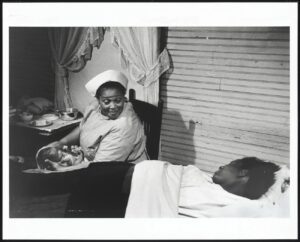 Photo Credit
NMAAHC, Smithsonian Institution — Doulas & Midwives
https://nmaahc.si.edu/explore/stories/historical-significance-doulas-and-midwives
The Tuskegee Institute Nurse Midwife Program began in the 1930s in Alabama to address high maternal and infant mortality rates in rural Black communities. The program trained African American nurse midwives to provide prenatal care, assist with childbirth, and educate families about infant care and hygiene.
At a time when many families had limited or no access to hospitals, these nurse midwives served as trusted healthcare providers within their communities. Their work contributed to measurable declines in maternal and infant deaths and expanded professional opportunities for Black women in healthcare.
The program demonstrated the effectiveness of culturally responsive, community based maternal care. Its focus on prevention, education, and continuity of care continues to influence modern maternal and child health practices today.
Carrying the Legacy Forward
Each of these efforts shows how community leadership, education, and access to care can improve health outcomes and strengthen public health systems. The work of Freedom House, the Free Health Clinics, and the Tuskegee Nurse Midwives helped shape emergency services, preventive care models, and the community health center movement that informs the FQHC model today.
At HJAHC, we continue this legacy by meeting patients where they are, reducing barriers to care, and delivering high quality, respectful services to our community.